


Why does my skin suddenly look knackered?
You know that moment when you look in the mirror and think, “I swear I looked fresher than this six months ago”?
You might be sleeping reasonably well. You might not have changed anything dramatic. Yet your skin suddenly looks duller, drier, a little more lined and somehow just… tired.
If you’re in your 40s or 50s, hormones may be one piece of the puzzle.
Perimenopause and menopause can affect far more than periods, hot flushes and sleep. The NHS recognises dry and itchy skin among the possible symptoms of menopause and perimenopause, and dermatologists also recognise changes in hydration, collagen, firmness, sensitivity and acne around this stage of life.
So if the skin you have known for years suddenly seems to have developed a mind of its own, you may not be imagining it.
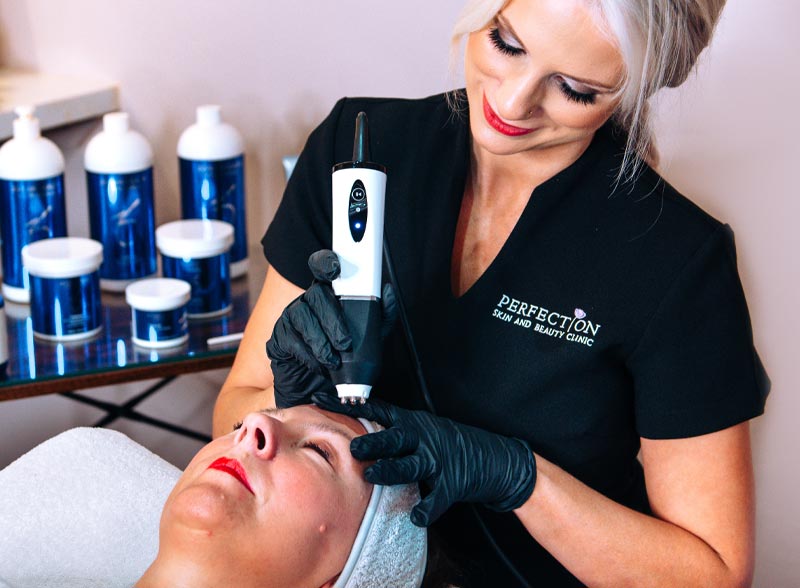
Can menopause actually change your skin?
Yes.
Your skin is responsive to oestrogen, and as oestrogen levels fall through perimenopause and menopause, changes can occur in the skin.
These may include:
- increased dryness
- reduced ability to retain water
- changes in collagen and elasticity
- thinner skin
- increased sensitivity or irritation
- adult acne
- slower healing
- changes in firmness
That does not mean menopause suddenly “ages” your face overnight.
Skin ageing is complicated.
Genetics, cumulative sun exposure, smoking, stress, illness, medication, lifestyle and normal chronological ageing can all affect how your skin looks and behaves too.
Two women can be exactly the same age and have completely different skin.
Why can my skin suddenly look so tired?
One reason is water.
During menopause, skin can lose some of its ability to retain water. When the skin is drier, the surface can become rougher and less smooth. Fine lines can look more noticeable and the skin may reflect light less evenly.
The result?
Skin that can look duller, flatter or more tired, even when you are not actually exhausted.
That is one of the reasons it can feel as though your face has changed overnight.
The biological changes themselves are usually gradual. Sometimes you simply reach the point where you suddenly notice them.
Possibly under the particularly unforgiving lighting of a bathroom mirror.
Does menopause affect collagen?
Yes, there is good evidence that falling oestrogen is associated with collagen loss.
Collagen is one of the proteins that gives the skin much of its strength and structure.
As collagen reduces, the skin can gradually become thinner and less firm.
The American Academy of Dermatology reports that collagen loss can be particularly rapid during the first years of menopause, before becoming more gradual.
This does not mean every change in your jawline, cheeks or face is purely hormonal.
Years of sun exposure matter enormously too.
UV exposure contributes to the breakdown of collagen and visible skin ageing, which is why the effects we notice in our 40s and 50s are often the result of several things happening together.
Why has my skin suddenly become more sensitive?
This can be incredibly frustrating.
You may have used the same products happily for years, then suddenly find that your skin stings, feels tight or becomes red and irritated much more easily.
The temptation is often to attack the problem.
More exfoliation.
A stronger acid.
Another serum.
A higher percentage of something because somebody online said it transformed their skin.
This is where it is worth stopping.
Healthy skin is not skin that has been scrubbed, peeled or stripped into submission.
If your skin is persistently tight, red, flaky or stinging, adding more aggressive products may simply increase irritation.
Stronger does not automatically mean better.
Why am I getting spots when my skin is dry?
This one feels particularly unfair.
You absolutely can have dry skin and spots at the same time.
Hormonal changes around menopause can contribute to adult acne.
That is why treating every blemish as though you are 16 again is not necessarily a sensible approach.
Aggressively drying acne-prone skin can irritate it further, and the American Academy of Dermatology specifically warns that teenage acne treatments may be too harsh for skin that has become thinner and drier around menopause.
The better question is not simply:
“How do I get rid of this spot?”
It is:
“Why is my skin behaving this way now?”
What should a good skincare routine actually be doing?
Instead of immediately asking, “What should I buy?”, start by asking what your skin is actually doing.
- Does it feel comfortable after cleansing?
- Is it constantly tight?
- Does it sting?
- Has it become easily irritated?
- Have you developed spots, pigmentation or redness?
- Does your skin seem dull or rough?
- Are you using multiple active ingredients at the same time?
- Has your skin changed noticeably over the last few years?
These questions tell you much more than your age does.
A sensible approach should focus on supporting healthy skin function, encouraging appropriate cell turnover, protecting the skin from further damage and addressing specific concerns rather than throwing everything at it at once.
Do I need stronger active skincare now that I am older?
Not necessarily.
Active ingredients can be extremely useful, but more is not automatically better.
Retinoids, antioxidants and exfoliating acids can all have a useful place in skincare when they are appropriate for the person using them.
That does not mean everyone needs all three, every night, at maximum strength.
Constant redness, stinging and peeling are not proof that a skincare routine is working brilliantly.
They may simply be signs that you have overdone it.
This is particularly important if your skin has become more reactive during perimenopause or menopause.
Why does sun protection still matter in my 40s and 50s?
Because UV damage does not stop accumulating just because summer has finished.
Sun exposure contributes to collagen breakdown, pigmentation and visible skin ageing.
Dermatology guidance recommends broad-spectrum sun protection every day, including during winter.
By the time we reach our 40s and 50s, much of our lifetime sun exposure has already happened.
We cannot change what we did twenty years ago.
We can protect the skin we have today from additional damage.
That is a much more useful way of looking at it.
Should I copy my friend’s skincare routine?
Please don’t.
Your friend might swear blind that a particular retinoid, serum, peel or skincare routine has transformed her face.
Wonderful.
It does not mean it is right for yours.
Your skin is influenced by your genetics, hormone levels, sun history, lifestyle, medical history, medication and everything you have previously used on it.
What suits your friend, neighbour or someone online may be completely wrong for you.
The best skincare routine is not necessarily the one containing the most products, the highest percentages or the biggest price tags.
It is the one that is appropriate for your skin.
Is every skin change in my 40s or 50s caused by menopause?
No.
This is really important.
Once we know that menopause can affect the skin, it becomes very easy to blame every new change on hormones.
That can be a mistake.
Persistent redness, itching, unexplained rashes, significant changes in pigmentation or a new or changing skin lesion should not automatically be dismissed as menopause.
The NHS confirms that dry and itchy skin can occur around menopause, but there are many other causes of skin symptoms too.
If something is new, persistent, changing or worrying you, speak to your GP or another appropriate medical professional.
A reputable skin professional should also know when something is outside their remit and needs referring.
What should happen during a professional skin consultation?
If you feel as though your bathroom cupboard has turned into a skincare laboratory and you still have absolutely no idea what your skin needs, it may be time to stop guessing.
Consider booking a consultation with a qualified skin professional at a reputable medispa or skin clinic.
A good consultation should not simply consist of somebody looking at your face for five minutes and handing you a shopping list.
They should ask questions.
- What has changed?
- When did you first notice it?
- What are you currently using?
- How does your skin feel?
- What are you actually hoping to improve?
- What is realistic?
- Are there things you should stop doing?
- Is there anything that needs referring to a doctor or dermatologist?
Most importantly, they should explain why they are recommending something.
You should leave understanding your own skin better than when you arrived.
Looking for advice about menopausal or changing skin in Wiltshire?
At Perfection MediSpa, we see women from across Wiltshire, Gloucestershire and the Cotswolds who tell us exactly the same thing:
“My skin just isn’t behaving like it used to.”
Perfection is an advanced skin and medispa clinic specialising in professional skin consultations and evidence-led skin treatments.
Our approach starts with understanding what is actually happening in your skin rather than assuming every woman of a certain age needs the same thing.
If you would like professional guidance, you can book a skin consultation with our team here.
The most important thing to remember
Your skin has not suddenly failed you.
It may simply be functioning differently from how it did ten years ago.
Getting older does not mean giving up on your skin.
It means learning to understand it better.
The goal is not to desperately chase the face you had at 25.
It is to help the skin you have today function as well as it possibly can, protect what you have, address the things that genuinely bother you and make informed decisions about what is actually worthwhile.
Your skin will continue to change throughout your life.
Understanding why it is changing gives you a much better chance of looking after it properly.
That is far more powerful than another miracle cream.
Frequently asked questions about menopause and skin
Can perimenopause make my skin dry?
Yes. Hormonal changes during perimenopause and menopause can affect the skin’s ability to retain water, and dry or itchy skin is a recognised menopause symptom.
Can menopause cause spots?
Hormonal changes around menopause can contribute to adult acne in some women. Skin can therefore be both drier and acne-prone at the same time.
Does menopause cause collagen loss?
Falling oestrogen is associated with reduced skin collagen, which can contribute to thinning and reduced firmness.
Why has my skincare suddenly started stinging?
Skin can become drier and more easily irritated around menopause. Strong active ingredients, over-exfoliation and introducing too many products can also contribute to irritation.
Do I need completely different skincare after menopause?
Not automatically. Your skincare should be based on what your skin is doing and the concerns you want to address rather than your age alone.
Should I see a professional about menopausal skin?
If you are struggling to understand what has changed, a qualified skin professional can help assess your skin, review what you are currently using and explain your options. Persistent or concerning skin changes should be assessed by an appropriate medical professional.
